

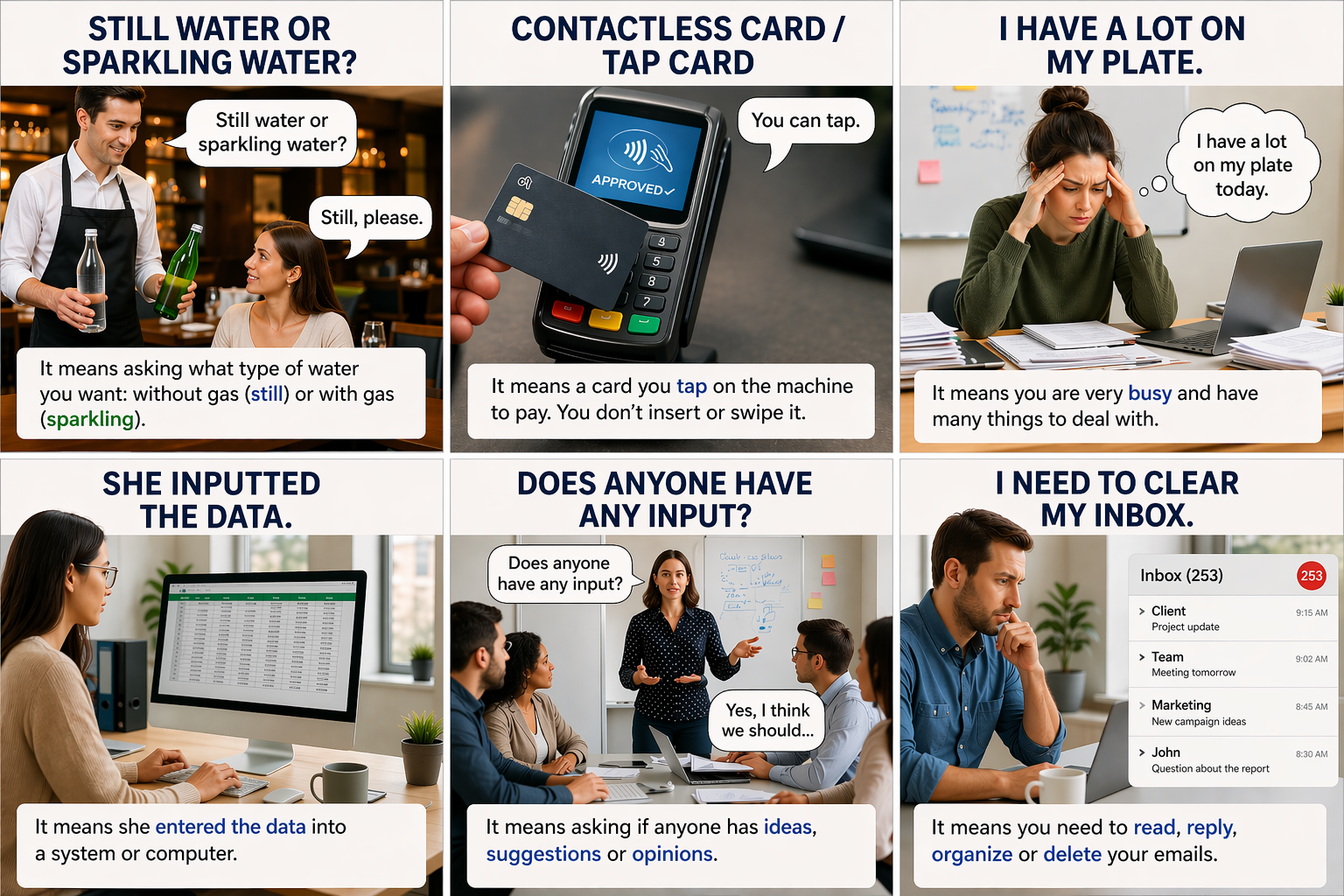
CONTACTLESS CARD/TAP CARD
Cartão de aproximação
STILL WATER OR SPARKLING WATER?
Àgua sem gás ou com gás?
I HAVE A LOT ON MY PLATE.
I’m very busy (estou muito ocupado).
SHE INPUTTED THE DATA.
Ela colocou a informação.
DOES ANYONE HAVE ANY INPUT?
Alguém tem alguma ideia ou opinião para compartilhar?
I NEED TO CLEAR MY INBOX.
Preciso responder os meus e-mails.
CONTACTLESS CARD/TAP CARD
Contactless card” or “tap card” is a payment card you don’t insert or swipe. You just tap it on the reader to pay. It uses NFC (wireless) technology.
- Contactless card = more formal term
- Tap card / tap-to-pay card = everyday language
Examples
- “You can use a contactless card for small purchases.”
- “Just tap your card on the machine.”
- “Do you accept tap cards?”
- “I paid with my contactless debit card.”
- “Tap your card — no PIN needed for amounts under $50.”
Also used with phones & watches
- “I used tap to pay on my phone.”
- “It’s contactless payment — no need to insert the card.”
What you might hear at a store
- “You can tap.”
- “Contactless is fine.”
- “Tap whenever you’re ready.”
STILL WATER OR SPARKLING WATER?
“Still water or sparkling water?” is a question asking what type of water you want.
- Still water = water without gas (água sem gás)
- Sparkling water = water with gas (água com gás)
Examples
At a restaurant:
- “Would you like still or sparkling water?”
- “Still, please.”
- “Sparkling, please.”
Other ways they might say it:
- “Flat or sparkling?”
- “Water with or without gas?”
- “Do you want still or fizzy water?”
Quick mini-dialogue
Waiter: “Still or sparkling?”
You: “Still, please.”
or
You: “Sparkling, please.”
I HAVE A LOT ON MY PLATE.
“I have a lot on my plate” means I’m very busy or I have many things to deal with right now.
It’s figurative — your “plate” = your responsibilities.
Examples
- “I can’t help this week — I have a lot on my plate.”
- “She’s stressed because she has a lot on her plate at work.”
- “With classes and meetings, I have a lot on my plate today.”
- “I’d love to go, but I’ve got a lot on my plate.”
Similar expressions
- “I’m swamped.”
- “I’m overwhelmed.”
- “I’m really busy.”
- “I have too much going on.”
Mini dialogue
“Can you take another student?”
“Not now — I have a lot on my plate.”
SHE INPUTTED THE DATA.
“She inputted the data.” means she entered the data into a system.
- to input data = colocar / inserir dados
- Used in admin, spreadsheets, systems, forms, etc.
Examples
- “She inputted the data into the spreadsheet.”
- “I input the numbers yesterday.” (more common)
- “Who input this information?”
- “The assistant is inputting the student records.”
Important detail
Both are correct:
- input (past) → She input the data. ✅ (more common)
- inputted (past) → She inputted the data. ✅ (also correct, less common)
Most native speakers prefer:
- “She input the data.”
DOES ANYONE HAVE ANY INPUT?
“Does anyone have any input?” means:
Does anyone have any ideas, suggestions, or comments?
Here input = opinion / contribution / feedback.
Examples
- “This is the new schedule. Does anyone have any input?”
- “Before I decide, does anyone have any input?”
- “I wrote this message — any input?”
- “We’re changing the rules. I’d like your input.”
Similar phrases
- “Any suggestions?”
- “Any thoughts?”
- “What do you think?”
- “Any feedback?”
- “Does anyone want to add anything?”
Mini-dialogue
“I’m thinking of moving your class to Tuesday. Does anyone have any input?”
“Yes — Tuesday works better for me.”
I NEED TO CLEAR MY INBOX.
“I need to clear my inbox.” means I need to deal with all my emails/messages — read them, reply, delete, organize.
Inbox = caixa de entrada (email, WhatsApp, etc.)
Examples
- “I need to clear my inbox before lunch.”
- “My inbox is full — I need to clear it.”
- “She spent the morning clearing her inbox.”
- “Let me clear my inbox, then I’ll call you.”
Similar phrases
- “I need to go through my emails.”
- “I need to catch up on emails.”
- “I need to answer my messages.”
- “My inbox is piling up.”
Mini-dialogue
“Can we talk now?”
“Give me 10 minutes — I need to clear my inbox first.”
Story:
On Monday morning, I walked into a café before work. The waiter smiled and asked, “Still or sparkling water?”
“Still, please,” I said, already checking my phone. My inbox was exploding. “Wow… I really need to clear my inbox before my first class.”
When it was time to pay, he said, “You can tap.”
I used my contactless card and quickly tapped the card on the machine. Done in one second.
At school, my assistant looked stressed. “I have a lot on my plate today,” she said. “New students, schedule changes, and payments.”
“I know,” I replied. “Did you finish the registrations?”
“Yes, I inputted the data into the system this morning.”
Later, during a quick meeting, I said, “I’m thinking of changing the evening schedule. Does anyone have any input?”
She nodded. “Yes — Tuesdays are getting too full. And… we both need to clear our inboxes before adding anything else.”
Exercise — Complete with the correct expression ✏️
Use these expressions:
- 💳 contactless card / tap card
- 💧 still or sparkling water
- 🍽️ I have a lot on my plate
- 💻 she inputted the data
- 💬 does anyone have any input?
- 📥 I need to clear my inbox
- At the restaurant, the waiter asked, “__________?”
- “I can’t take another class this week. __________.”
- Before paying, he said, “You can use your __________.”
- I can’t talk now — __________.
- The assistant finished the registrations. __________ into the system.
- We’re thinking of changing the schedule. __________?
Bonus — Choose the best option
- At a café:
- a) Still or sparkling water?
- b) Tap your inbox?
- c) Input your plate?
- When you’re very busy:
- a) I need to clear my water
- b) I have a lot on my plate
- c) Does anyone have any card?
- In a meeting:
- a) Does anyone have any input?
- b) Tap your data
- c) Sparkling your inbox
- Paying quickly:
- a) Use your still water
- b) Use your contactless card
- c) Input your payment