

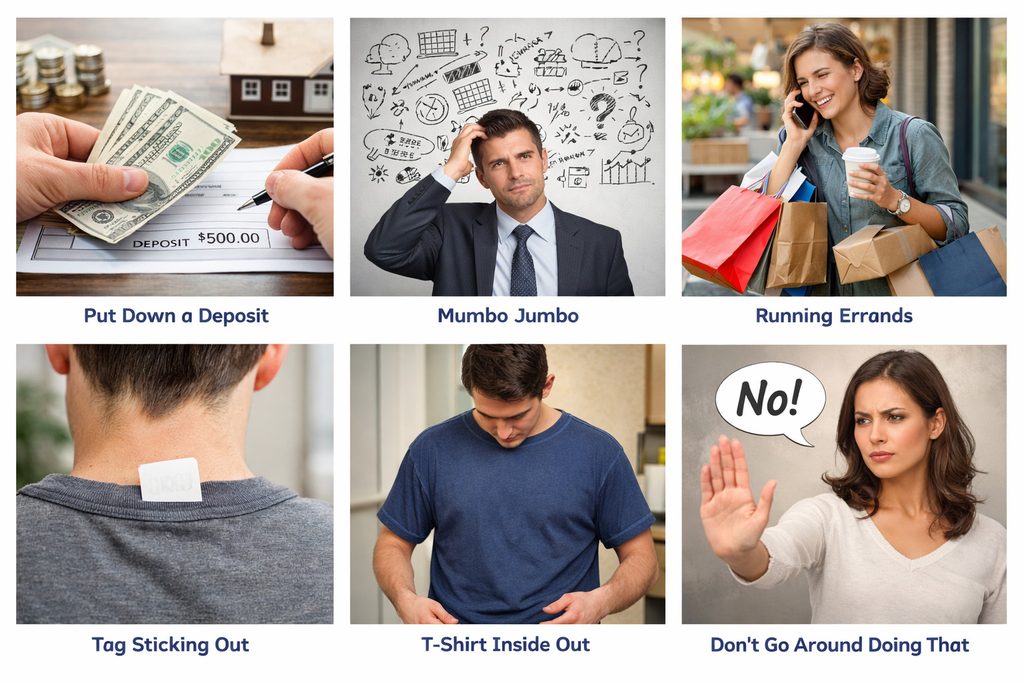
YOU HAVE TO PUT DOWN A $500,00 DEPOSIT,AND THAT’S JUST FOR STARTERS.
Você tem que dar $500,00 de sinal só pra começar.
THAT WAS FULL OF MUMBO JUMBO (MUMBLE JUMBLE).
Estava cheio de blá-blá-blá.
I WAS RUNNING ERRANDS.
Eu estava resolvendo coisas na rua.
I DON’T GO AROUND DOING THINGS LIKE THAT.
Não ando por aí fazendo essas coisas.
YOUR TAG IS STICKING OUT.
Sua etiqueta está aparecendo.
YOUR T-SHIRT IS INSIDE OUT.
Sua camiseta está do avesso.
🔹 Expression:
“You have to put down a $500 deposit, and that’s just for starters.”
🔹 Meaning:
- “put down a $500 deposit”
= pay an initial amount of money before getting something (like renting, buying, booking) - “that’s just for starters”
= that’s only the beginning; more (usually more money, effort, or requirements) will come after
👉 So the full sentence means:
You need to pay $500 now, and that’s only the beginning—there will be more to pay or do later.
🔹 Important note:
In English, we usually write:
- $500.00 (not $500,00)
🔹 Tips:
- Don’t say: ❌ “five hundred dollars deposit”
- Correct: ✅ “five hundred dollar deposit” (adjective form)
🔹 More examples:
- Buying a car
- You’ll need to put down $2,000, and that’s just for starters.
- Planning a wedding
- The venue costs $5,000, and that’s just for starters.
- Starting a business
- We’ve already invested $10,000, and that’s just for starters.
- Travel expenses
- The flights alone cost $1,200—and that’s just for starters.
- Home renovation
- Fixing the roof will be $3,000, and that’s just for starters.
🔹 Similar expressions:
- “That’s only the beginning”
- “That’s just the first step”
- “There’s more to come”
🔹 Expression:
“That was full of mumbo jumbo or mumble jumble.”
(The correct spelling is “mumbo jumbo,” not “mumble jumble” but still accepted by the Oxford English Dictionary as a variant. )
🔹 Meaning:
“Mumbo jumbo” = language or ideas that are:
- confusing
- meaningless
- overly complicated (often to sound intelligent or hide the truth)
👉 So:
“That was full of mumbo jumbo” means:
What was said or written didn’t make much sense or was unnecessarily complicated.
🔹 Examples:
- At a meeting
- The presentation sounded impressive, but it was full of mumbo jumbo.
- Reading a contract
- I tried to read the agreement, but it was all mumbo jumbo to me.
- Talking about technology
- He kept using technical terms—just mumbo jumbo, honestly.
- School / lectures
- The professor’s explanation was full of mumbo jumbo.
- Advertisements
- That ad is full of marketing mumbo jumbo.
🔹 Similar expressions:
- “It didn’t make sense”
- “It was all nonsense”
- “It went over my head” (I didn’t understand it)
- “Too much jargon”
🔹 Tip:
Sometimes it can sound a bit critical or informal, so it’s best used in casual conversations.
🔹 Expression:
“I was running errands.”
🔹 Meaning:
“to run errands” = to go out and do several small tasks, usually things you need to take care of in daily life
These tasks are usually quick but necessary, like:
- going to the bank
- buying groceries
- picking something up
- going to the post office
👉 So:
“I was running errands” means:
I was out doing small everyday tasks.
🔹 Examples:
- Sorry I didn’t answer—I was running errands.
- She spent the morning running errands around town.
- I need to run a few errands before work.
- We were running errands all afternoon.
- He’s out running errands right now.
🔹 Common combinations:
- run some errands
- run a few errands
- run errands around town
- quick errands
🔹 Similar expressions:
- “I was out and about” (more general)
- “I was taking care of things”
- “I was doing some chores” (more at home)
🔹 Expression:
“I don’t go around doing things like that.”
🔹 Meaning:
This means:
👉 I don’t (normally / habitually) behave like that.
👉 That’s not the kind of person I am.
- “go around doing something” = do something repeatedly or as a general behavior (often negative or questionable)
🔹 Tone:
It’s often used to:
- defend yourself
- deny a habit
- show disapproval of an action
🔹 Examples:
- I don’t go around lying to people.
- She doesn’t go around breaking the rules.
- I don’t go around spending money like that.
- He doesn’t go around talking to strangers.
- We don’t go around causing trouble.
🔹 Compare:
- “I didn’t do that.” → talking about one situation
- “I don’t go around doing that.” → talking about your general behavior
🔹 Similar expressions:
- “That’s not like me.”
- “I’m not that kind of person.”
- “I wouldn’t normally do that.”
🔹 Expression:
“Your tag is sticking out.”
🔹 Meaning:
- tag = the label on clothes (usually inside, with size/brand)
- sticking out = visible when it shouldn’t be
👉 So the sentence means:
The label of your clothes is showing, and you might want to fix it.
🔹 When do we use it?
To politely tell someone:
- their clothing label is visible
- something looks slightly out of place
It’s usually said to help, not criticize 😊
🔹 Examples:
- Hey, your tag is sticking out.
- Excuse me, your tag is sticking out at the back.
- Your shirt tag is sticking out—you might want to tuck it in.
- His tag was sticking out the whole time!
- I didn’t realize my tag was sticking out.
🔹 Similar expressions:
- “Your shirt is inside out.”
- “Your zipper is open.”
- “You’ve got something on your shirt.”
- “Your collar is flipped up.”
🔹 Tip:
This is a friendly and considerate comment—people usually appreciate it because it helps them avoid embarrassment.
🔹 Expression:
“Your T-shirt is inside out.”
🔹 Meaning:
- inside out = when the inside of your clothes is on the outside (the wrong side is showing)
👉 So the sentence means:
You’re wearing your T-shirt the wrong way—the inside is showing instead of the outside.
🔹 Examples:
- Hey, your T-shirt is inside out.
- I didn’t notice my shirt was inside out all day!
- He came to work with his T-shirt inside out.
- She quickly fixed her shirt—it was inside out.
- Oops! My clothes are inside out.
🔹 Similar / related expressions:
- “Your tag is sticking out.” (less serious, small detail)
- “You’re wearing it backwards.” (front/back reversed)
- “Your zipper is open.”
- “Your shirt is wrinkled.”
🔹 Difference from the previous one:
- “Your tag is sticking out” → small issue (just the label showing)
- “Your T-shirt is inside out” → bigger mistake (the whole shirt is wrong)
🔹 Tip:
Like the previous expression, this is usually said to help someone politely—you can start with:
- “Hey,”
- “Excuse me,”
🌟 MINI LESSON: Everyday English Expressions
🔹 Target expressions:
- put down a deposit / that’s just for starters
- mumbo jumbo
- run errands
- don’t go around doing that
- your tag is sticking out
- your T-shirt is inside out
🟢 A1–A2 (Beginner)
1. Match the expressions to the meanings:
a. running errands
b. inside out
c. tag is sticking out
- ( ) doing small daily tasks
- ( ) clothes are the wrong way
- ( ) the label is showing
2. Complete the sentences:
- I am __________ errands.
- Your T-shirt is __________ out.
- Your tag is __________ out.
3. Speaking (very simple):
Practice with a partner:
- Hey, your tag is sticking out.
- Oh, thanks!
🟡 B1 (Intermediate)
1. Fill in the blanks:
Use:
mumbo jumbo / running errands / inside out / go around
- Sorry, I was __________.
- This text is full of __________.
- I don’t __________ doing that.
- My shirt is __________.
2. Rewrite (same meaning):
- I was out doing small tasks.
→ I was ______________________. - That doesn’t make sense.
→ That’s ______________________. - That’s not my behavior.
→ I don’t ______________________.
3. Short dialogue:
Complete:
A: Where were you?
B: I was ______________________.
A: And this document?
B: Honestly, it’s full of ______________________.
🔵 B2 (Upper Intermediate)
1. Complete the story:
Use ALL expressions:
Yesterday was a busy day. I was __________________ all morning.
Then I had a meeting, but the presentation was full of __________________.
They said I had to put down a $500 deposit, and that was just for __________________.
I told them I don’t __________________ doing things like that.
When I got home, my friend laughed and said my T-shirt was __________________ and my tag was __________________!
2. Discussion questions:
- Have you ever worn something inside out by mistake?
- What kind of situations are full of mumbo jumbo?
- What errands do you usually run during the week?
- When do people say “that’s just for starters”?
✅ ANSWER KEY
A1–A2:
- a-1 / b-2 / c-3
- running / inside / sticking
B1:
- running errands
- mumbo jumbo
- go around
- inside out
Rewrites (possible answers):
- running errands
- mumbo jumbo
- go around doing that
B2:
- running errands
- mumbo jumbo
- starters
- go around
- inside out
- sticking out
📖 Story: What a Day!
Mark woke up early, knowing it was going to be a busy day. First, he had a meeting with a landlord about a new apartment.
When he arrived, the landlord smiled and said,
“You’ll have to put down a $500 deposit, and that’s just for starters.”
Mark’s eyes widened. Just for starters? He was already worried.
Then the landlord started explaining the contract. He used complicated words and long explanations. After a few minutes, Mark thought,
“This is all mumbo jumbo. I don’t understand anything!”
After the meeting, Mark went out. He spent the whole afternoon running errands—going to the bank, the supermarket, and the pharmacy.
Later, the landlord called him again and asked for even more money. That was too much. Mark replied,
“Listen, I don’t go around doing things like that.”
Finally, tired and frustrated, Mark went home.
As soon as he walked in, his wife looked at him and tried not to laugh.
“Mark… your T-shirt is inside out,” she said.
Mark looked down in shock. “What?!”
“And… your tag is sticking out, too!” she added.
Mark sighed, sat on the couch, and said,
“Well… what a day.”