

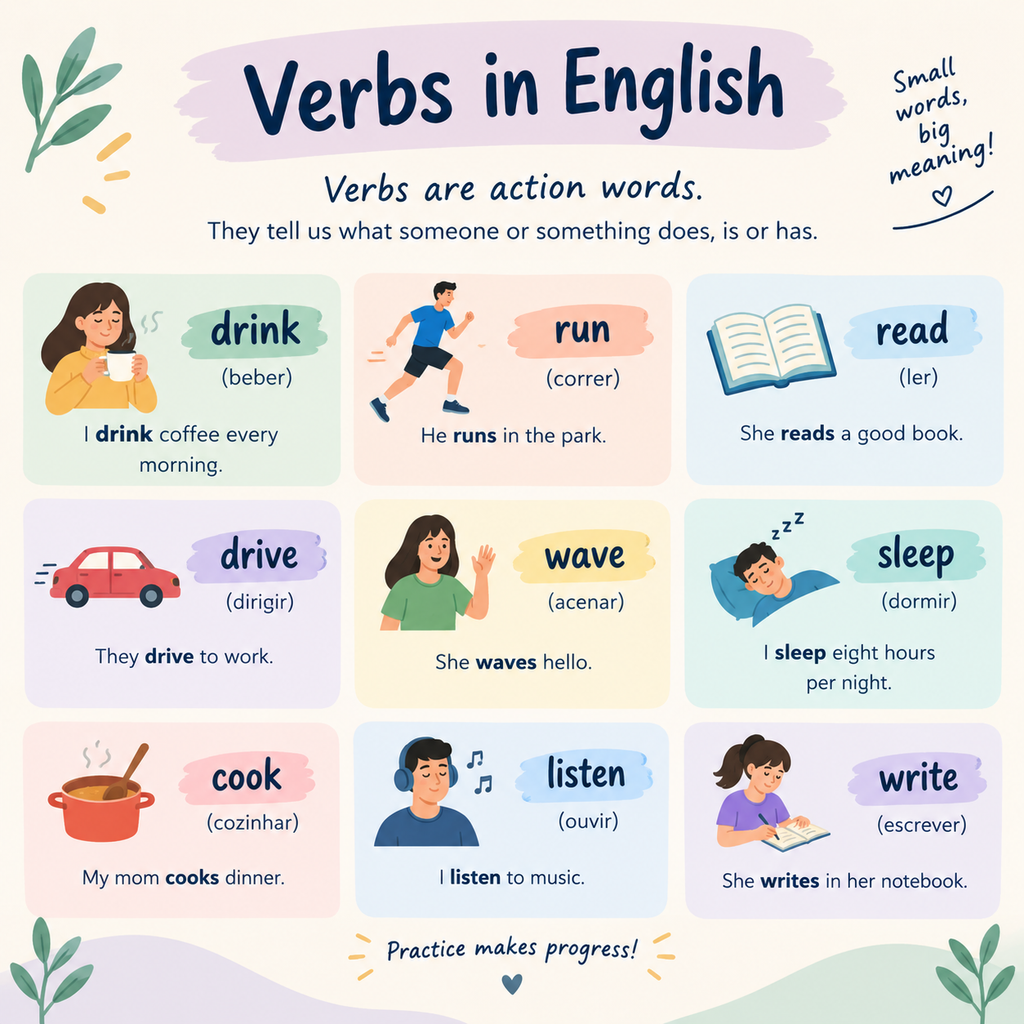
Let’s use the verb TO WORK as our main example.
1. Present tenses
1. Simple Present
Form: subject + base verb (add -s/-es for he, she, it)
Example: She works in a hospital.
When to use it: Habits, routines, facts, general truths, and permanent situations.
More examples: I teach English. / The sun rises in the east.
2. Present Continuous
Form: am/is/are + verb-ing
Example: She is working right now.
When to use it: Actions happening now, temporary situations, and arranged future plans.
More examples: I’m studying English. / We’re meeting tomorrow.
3. Present Perfect
Form: have/has + past participle
Example: She has worked here for five years.
When to use it: Past actions connected to the present, life experiences, recent events, and situations that began in the past and continue now.
More examples: I’ve visited London. / He has just arrived.
4. Present Perfect Continuous
Form: have/has been + verb-ing
Example: She has been working all morning.
When to use it: Actions that started in the past and continue now, or recently stopped with a present result. Emphasizes duration or activity.
More examples: I’ve been learning English for two years. / She’s tired because she’s been running.
2. Past tenses
5. Simple Past
Form: verb + -ed (regular verbs) or past form (irregular verbs)
Example: She worked yesterday.
When to use it: Completed actions at a definite time in the past.
More examples: I saw him last week. / They went to Brazil in 2024.
6. Past Continuous
Form: was/were + verb-ing
Example: She was working at 8 p.m.
When to use it: Actions in progress at a particular time in the past, background actions, or an action interrupted by another.
More examples: I was cooking when he called. / They were sleeping at midnight.
7. Past Perfect
Form: had + past participle
Example: She had finished work before I arrived.
When to use it: An action completed before another past action or past reference time.
More examples: He had already left when we got there. / I had never seen snow before that trip.
8. Past Perfect Continuous
Form: had been + verb-ing
Example: She had been working for three hours when I arrived.
When to use it: An activity that continued for a period before another past event, emphasizing its duration or its effect.
More examples: They had been driving for hours before they stopped. / He was tired because he had been exercising.
3. Future tenses
9. Simple Future
Form: will + base verb
Example: She will work tomorrow.
When to use it: Predictions, spontaneous decisions, promises, offers, and future expectations.
More examples: I think it will rain. / I’ll help you.
10. Future Continuous
Form: will be + verb-ing
Example: She will be working at 10 a.m. tomorrow.
When to use it: An action that will be in progress at a particular time in the future.
More examples: This time tomorrow, I’ll be flying to Paris. / We’ll be waiting for you.
11. Future Perfect
Form: will have + past participle
Example: She will have finished work by 5 p.m.
When to use it: An action that will be completed before a specific future time or event.
More examples: By June, I’ll have graduated. / They will have arrived by noon.
12. Future Perfect Continuous
Form: will have been + verb-ing
Example: By June, she will have been working here for ten years.
When to use it: To emphasize how long an activity will have continued up to a particular future time.
More examples: By 6 p.m., I’ll have been studying for four hours. / Next month, they’ll have been living here for a year.
4. Quick comparison table
This condensed version is useful for reviewing all 12 tenses at a glance.
| Tense | Example | Main use |
| Simple Present | I work. | Habits and facts |
| Present Continuous | I am working. | Happening now |
| Present Perfect | I have worked. | Past connected to now |
| Present Perfect Continuous | I have been working. | Duration up to now |
| Simple Past | I worked. | Completed past action |
| Past Continuous | I was working. | Action in progress in the past |
| Past Perfect | I had worked. | Before another past event |
| Past Perfect Continuous | I had been working. | Duration before a past event |
| Simple Future | I will work. | Predictions and decisions |
| Future Continuous | I will be working. | In progress in the future |
| Future Perfect | I will have worked. | Completed by a future time |
| Future Perfect Continuous | I will have been working. | Duration up to a future time |
5. The four patterns students should recognize
Simple
The action is presented as a fact, habit, completed event, or whole event.
I work every day.
Continuous
Focuses on an action in progress or an ongoing activity.
I am working now.
Perfect
Connects an earlier action to a later reference point, often emphasizing completion or a result.
I have finished my work.
Perfect Continuous
Emphasizes the duration or ongoing nature of an activity up to a reference point.
I have been working for three hours.
6. Important note
English also uses other ways to talk about the future, especially be going to, the present continuous, and the simple present.
- Will: I think it will rain.
- Be going to: Look at those clouds! It’s going to rain.
- Present continuous: I’m meeting my friend tonight.
- Simple present: The train leaves at 7 a.m.
These are essential future constructions, although be going to is not usually counted as one of the traditional 12 tense forms.
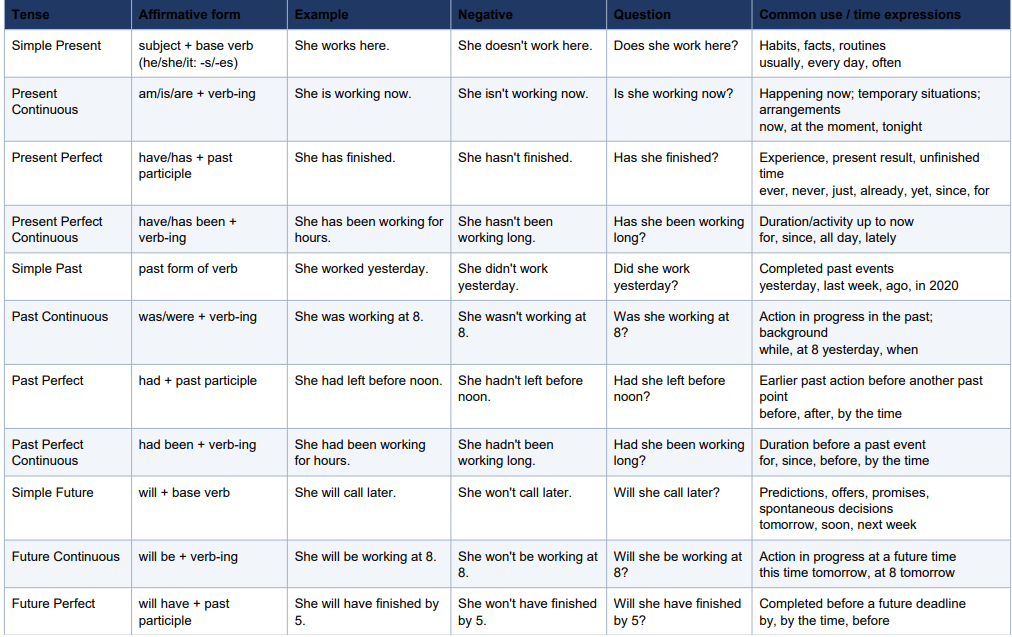
PART 1 — THE 12 MAIN TENSES

PART 2 — PRACTICE WORKSHEET
A. Complete each sentence with the correct form of the verb in parentheses.
- My brother usually __________________ (take) the bus to work.
- Be quiet! The baby __________________ (sleep).
- I __________________ never __________________ (try) sushi.
- She __________________ (study) for two hours, and she is still studying.
- We __________________ (visit) our grandparents last Sunday.
- At 9 p.m. yesterday, I __________________ (watch) a documentary.
- When we arrived, the movie __________________ already __________________ (start).
- He was exhausted because he __________________ (run) for an hour.
- I think people __________________ (use) more electric cars in the future.
- This time tomorrow, we __________________ (fly) to Lisbon.
- By Friday, they __________________ (complete) the project.
- By next May, I __________________ (teach) here for fifteen years.
B. Rewrite each sentence as indicated. - She works on Saturdays. (Make it negative.)
- They are having lunch. (Make a yes/no question.)
- He bought a new phone. (Make it negative.)
- You had finished the report. (Make a yes/no question.)
- She will be waiting outside. (Make it negative.)
- They have been living here for a year. (Make a yes/no question.)
C. Choose the best tense and complete the sentence.
19. I can’t go out now. I __________________ (do) my homework.
20. We __________________ (know) each other since 2018.
21. While I __________________ (drive) to work, I heard the news.
22. By the time you get home, I __________________ (cook) dinner.
23. She __________________ (leave) before I got to the station, so I missed her.
24. At this time next week, they __________________ (relax) on the beach.
D. Identify the tense used in each sentence.
25. They have been waiting since noon. __________________________________________
26. I will have finished by 7 p.m. __________________________________________
27. He was sleeping when the phone rang. ________________________________________
28. She visits her aunt every month. ________________________________________
PART 3 — ANSWER KEY
A. Complete the sentences
- takes
- is sleeping
- have never tried
- has been studying
- visited
- was watching
- had already started
- had been running
- will use
- will be flying
- will have completed
- will have been teaching
B. Rewriting - She doesn’t work on Saturdays.
- Are they having lunch?
- He didn’t buy a new phone.
- Had you finished the report?
- She won’t be waiting outside.
- Have they been living here for a year?
C. Choose the best tense - am doing
- have known
- was driving
- will have cooked
- had left
- will be relaxing
D. Identify the tense - Present Perfect Continuous
- Future Perfect
- Past Continuous (with Simple Past: “rang”)
- Simple Present
Teaching tip: Time expressions are clues, not absolute rules. Choose the tense based on the meaning and context of the whole sentence.